What if the Middle Ages still had something to teach us about waste?
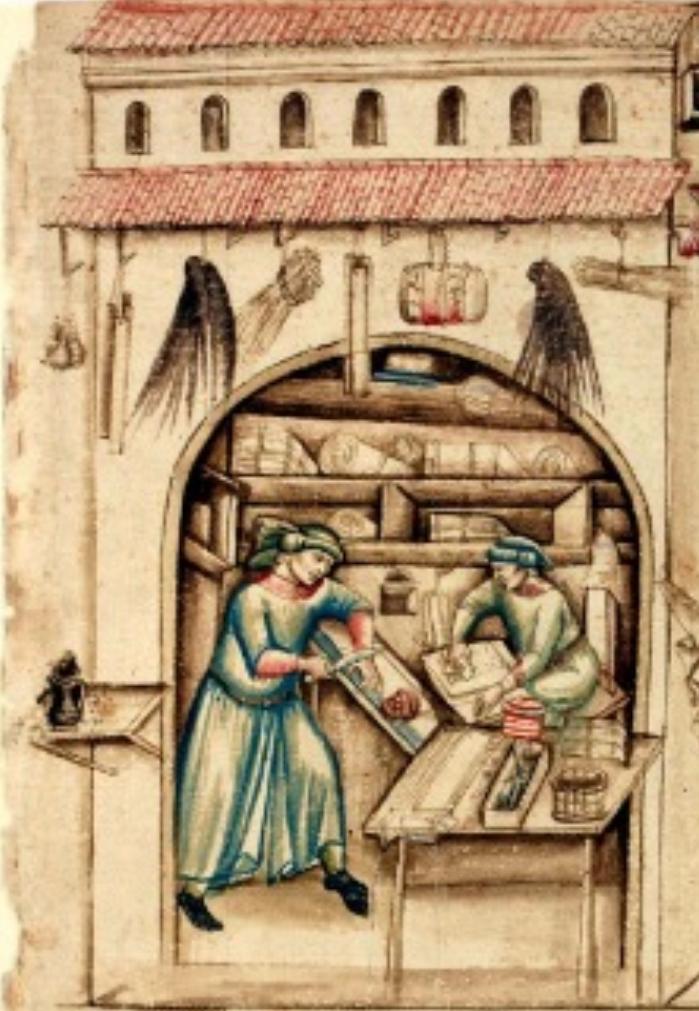
Scraped parchment leaves, cut into strips for subsequent reuse in other codices.
Bologna, Biblioteca Universitaria, ms. 1456, fol. 4r
When you hear the phrase circular economy, you probably think of recycling bins, sustainability targets and urgent debates about the future of our planet. It sounds like a thoroughly twenty-first-century idea.
But what if the story began much earlier?
Imagine medieval Tuscany. In Florence, a well-made cloak finds a second owner. In Pisa, worn linen and discarded rags crossed the customs house on their journey to becoming pulp and, eventually, fine paper. In Arezzo a blacksmith salvages iron from broken tools to forge something new. In a charitable hospital, garments are repaired and redistributed to those in need…
To the people who lived these scenes, nothing about them was remarkable. Yet they reveal an extraordinary truth: long before sustainability became a global concern, medieval societies had developed sophisticated ways of extending the lives of things.
Clothes were patched and altered, timber reused, metals melted down and reworked, household goods repaired rather than discarded. This was not environmentalism in the modern sense. Resources were precious, craftsmanship mattered, and value did not end with first use. Objects were expected to endure.
This website invites you to explore that world.
Drawing on the archives of Florence, Pisa and Arezzo, it uncovers the hidden afterlives of medieval objects and the people who shaped them. Through account books, customs registers, guild statutes and hospital records, we encounter merchants and artisans, widows and labourers, civic officials and charitable institutions grappling with questions that still resonate today.
Is it better to repair or replace? Who decides whether a reused object can be trusted? How is value assigned to things that are no longer new? When does waste become a resource?
You will discover thriving second-hand markets, regulations designed to protect consumers from disguised counterfeits, taxes on used goods crossing city boundaries, and institutions that organised the collection, repair and redistribution of everyday necessities. You will meet the rigattieri-dealers in second-hand wares-whose trade helped clothe entire communities.
At its heart, this is a story about creativity, resourcefulness and adaptation. History cannot provide ready-made solutions to contemporary challenges. What it can do is broaden our imagination and deepen our understanding of the many ways human societies have confronted limits, managed resources and assigned value to the material world around them.
This website grows out of the research project ReLMI. Use It Up, Wear It Out, Make Do or Do Without. Reuse, Repair and Recycle in Late Medieval Italy (13th-15th centuries), currently hosted at the University of Valencia, Spain. ReLMI has received funding from the European Union's Horizon Europe 2022 Research and Innovation Programme under the Marie Skłodowska-Curie Actions (Grant Agreement No. 101107286). Through extensive archival research, the project investigates the role of reuse, repair and recycling in late medieval Italy, revealing how individuals, institutions and markets participated in what we might now recognise as a culture of durability.
In an age increasingly shaped by disposability, the medieval past offers an unexpected invitation: to look again at the objects that fill our lives and recognise that their worth has never rested solely in their novelty. It has also resided in their ability to endure, to be repaired, transformed, and given another life.
Welcome to medieval Tuscany - a world where almost nothing was ever truly wasted.